Assembled by one person comparing general price lists against the text of the regulation that governs them, then writing down what the numbers turned out to mean.
The casket room is arranged the way a car lot is arranged, with the expensive models at eye level near the door and the plain ones grouped in a corner or shown only in a binder. The prices attached to them describe four different things at once: the raw material, the thickness of that material, the interior fabric and hardware, and the promise, sometimes stated and sometimes only implied, about what will happen underground. A careful reader separates those four, because only two of them are visible at a viewing and only one of them is ever inspected again.
Steel, and what the gauge number is telling you
Steel caskets are sold by gauge, and the number runs backward: 20 gauge is thinner than 18, and 18 is thinner than 16. The difference between them is measured in fractions of a millimeter of sheet steel, and at a viewing, with the lid open and the interior dressed, a 20 gauge shell and a 16 gauge shell look substantially alike. The price gap between them is not small. Copper and bronze cost more again, and are priced by the pound rather than by gauge, since they do not rust the way steel does.
What the extra gauge buys is rigidity and a heavier lid, which matters mainly to the people carrying it and to the finish, since thicker steel holds a deep automotive-style paint job with fewer ripples. It does not buy time. Once a casket is in the ground, the variables that govern it are soil moisture, drainage, and the water table, none of which appear on a price list. A funeral home that says so plainly is telling you something useful, and the ones that do tend to be easy to work with on everything else.
Hardwood, veneer, and cloth-covered board
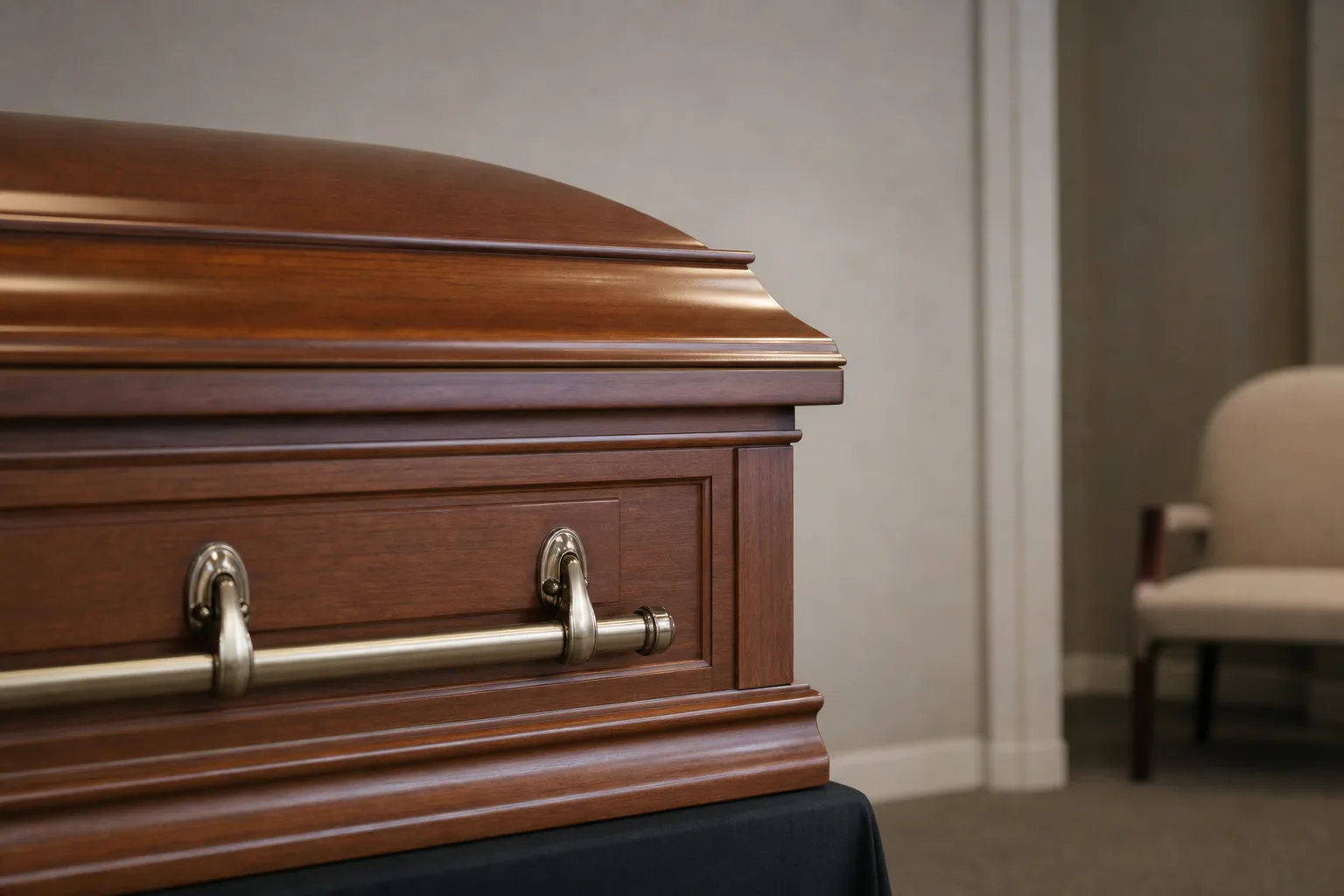
Solid hardwood caskets are priced by species, with poplar and pine at the bottom, oak, maple, and cherry in the middle, and mahogany, walnut, and black cherry at the top. Grain and finish are what you are paying for, and unlike gauge, that difference is genuinely visible from four feet away in a viewing room. Below the solid woods sit veneered caskets, which have a thin layer of the expensive species over a cheaper core, and below those sit cloth-covered particleboard, which is a wood-composite shell wrapped in fabric, usually crepe or velvet in gray, blue, or tan.
Cloth-covered units are the least expensive full-size casket most firms stock, and they are frequently the model kept out of the main display. They photograph well and, closed, read to most people as simply a plain casket. They are entirely appropriate for a viewing, for a church service, and for burial. If the one in the binder is not on the floor, ask to see it, and ask whether it can be ordered in another color, because the fabric options are usually broader than the single sample shown.
Sealing gaskets, liners, and what the cemetery actually requires
A sealed or protective casket has a rubber gasket and a locking bar that close the lid against air and water. The Federal Trade Commission oversees funeral sales practice under its Funeral Rule, and no seller may claim that a gasket preserves remains. Ask what the gasket is warranted to do and read the warranty itself; most warrant the casket against the entry of water for a term of years, which is a promise about the box, not about its contents. In wet ground, a sealed unit can trap moisture rather than exclude it.
Grave liners and burial vaults are a separate purchase, and here the requirement is real but narrow. Most cemeteries require an outer container so the grave does not subside under mowing equipment, and a plain concrete grave liner satisfies that requirement everywhere it exists. Lined, reinforced, and sealed vaults, and the ones finished in bronze or stainless, are upgrades sold on the same preservation reasoning as gaskets. Ask the cemetery, not the funeral home, to state its minimum in writing, and buy to that line.
Cremation containers and urns
For cremation, the crematory needs a rigid, combustible container, and an unfinished wood or heavy cardboard alternative container costs a small fraction of a casket. If there is a viewing first, many firms rent a hardwood outer shell with a removable insert, which is a real saving worth asking about by name. Urns are unregulated goods with no functional minimum, and a cemetery niche or a shipping requirement may set the size or the material. Check the niche dimensions and the volume in cubic inches before choosing, since fit is the only technical constraint.
The useful habit in all of this is to ask what a given feature does, ask who requires it, and ask for that requirement in writing from whoever is imposing it. Sellers who answer those three questions directly make the rest of the arrangement straightforward.